


How much CBD does your body actually absorb? Explore how gummies, tinctures, vaping, and topical products compare, why dietary fats matter, and practical ways to make more informed CBD choices.


Editor's Note (2026):
Originally published in January 2025, this guide has been comprehensively updated to reflect the evolving CBD marketplace and Green Bee Life's commitment to consumer education.
In this refreshed edition, we've expanded the article beyond simply defining CBD products. You'll also learn how to understand CBD extracts, compare product formats, interpret common terminology found on product labels, and evaluate key educational resources such as Certificates of Analysis (COAs).
As research, regulations, and product innovation continue to evolve, our mission remains the same: to help people build the knowledge and confidence to make informed decisions for themselves and their families.
Walk into almost any health store or browse an online marketplace, and you'll quickly encounter terms like full-spectrum, broad-spectrum, CBD isolate, nano CBD, tinctures, softgels, gummies, and topicals. If you've ever wondered what those terms actually mean—or why they matter—you're not alone.
I remember feeling much the same way when I first began researching CBD products for my dog. It didn't take long to realize that understanding the terminology was just as important as understanding the product itself.
Fortunately, learning the language of CBD is easier than it may seem. Once you understand a few foundational concepts, comparing products and interpreting labels becomes much more straightforward. You'll be better equipped to read product labels, compare formulations, evaluate marketing claims, and choose products that align with your individual preferences and goals.
This guide introduces the terminology you'll encounter most often and explains how different CBD extracts, product formats, and common industry terms relate to one another. Along the way, we'll point you to additional Green Bee Life resources that explore topics such as How to Read a CBD Label Like a Pro, Certificates of Analysis (COAs), and CBD vs. THC in greater depth.
Cannabidiol (CBD) is one of more than 140 naturally occurring cannabinoids identified in the cannabis plant.1 9 While CBD and tetrahydrocannabinol (THC) are the two best-known cannabinoids, the plant also contains dozens of other naturally occurring cannabinoids—often referred to as minor cannabinoids—that continue to be studied for their unique characteristics and potential roles within the plant.
Today, hemp-derived CBD is available in a wide variety of product formats, including oils, capsules, gummies, beverages, topicals, pet products, and more. But choosing a product involves more than selecting a format—it's also important to understand what's inside that product.
CBD products can differ in the type of CBD extract they contain, the cannabinoids and other naturally occurring plant compounds they include, and the additional ingredients used to create the final formulation. Some products contain only CBD, while others combine CBD with cannabinoids such as CBG or CBN, botanical ingredients like lavender or valerian root, or other functional ingredients intended for specific uses.
Understanding these differences is one of the keys to comparing CBD products with confidence—and that's exactly what we'll explore throughout this guide.
If you're new to CBD—or simply looking for a deeper understanding—we recommend starting with our foundational guide, What Is CBD? There, you'll learn how CBD differs from THC, how it interacts with the body's endocannabinoid system (ECS),1 and what current research does—and does not—tell us.
products contain the same type of CBD extract. Understanding what those extracts are—and how they differ—can make it much easier to interpret product labels, compare formulations, and choose products with confidence.
In this context, an extract refers to the collection of naturally occurring compounds that remain after cannabinoids and other plant constituents are extracted from hemp.
Understanding the three primary CBD extract types can help you interpret product labels, compare formulations, and better understand what's inside the products you're considering.
Full-spectrum CBD contains CBD along with the full range of naturally occurring compounds found in the hemp plant, including minor cannabinoids, terpenes, flavonoids, and trace amounts of THC (within the legal limit for hemp-derived products in the United States). 3
Because these compounds remain together, full-spectrum CBD provides the broadest representation of the hemp plant's naturally occurring cannabinoids, terpenes, flavonoids, and other beneficial plant compounds. Many people choose full-spectrum products because they prefer a more complete, whole-plant extract and are interested in what is known as the entourage effect—the idea that naturally occurring cannabinoids, terpenes, flavonoids, and other plant compounds may interact differently together than they do individually.7 While research continues to explore these interactions, many consumers and practitioners consider the entourage effect an important reason to choose full-spectrum products.
Broad-spectrum CBD also contains CBD along with a variety of other cannabinoids and naturally occurring plant compounds, but it is processed to remove THC. This option appeals to people who want a broader cannabinoid profile while avoiding THC.
CBD isolate is the most refined form of CBD, containing only cannabidiol (CBD). During processing, the other naturally occurring cannabinoids, terpenes, flavonoids, and plant compounds are removed, resulting in a purified extract that contains CBD alone.
The comparison below summarizes the primary differences between the three most common CBD extract types.

If you've spent time researching CBD, you've probably come across the term entourage effect. It describes the theory that cannabinoids, terpenes, flavonoids, and other naturally occurring compounds in the cannabis plant may interact differently when present together than when used individually. 7
Researchers continue to study this concept, and while scientific interest remains high, our understanding of the entourage effect continues to evolve. For many people, however, it remains one of the factors they consider when choosing between full-spectrum, broad-spectrum, and CBD isolate products.
Related Reading:
Think of it this way: Imagine listening to a single violin. It's beautiful on its own. Now imagine hearing a jazz trio, where each instrument adds depth and harmony. Finally, imagine a full orchestra, where dozens of instruments contribute to a richer, more complex performance. While no analogy is perfect, some people think of CBD isolate, broad-spectrum CBD, and full-spectrum CBD in a similar way. The more naturally occurring plant compounds that remain together, the more complex the overall composition becomes.

In addition to the three primary extract types, you may also see products labeled Nano CBD, Nano-Optimized CBD, or Nanoemulsified CBD.
Unlike full-spectrum, broad-spectrum, or CBD isolate, Nano CBD is not a different type of CBD extract. Instead, it refers to CBD that has undergone an additional manufacturing process called nanoemulsification, which reduces CBD particles into much smaller droplets.
Because CBD is naturally oil-soluble rather than water-soluble, it can be difficult to incorporate into beverages and other water-based products. Nanoemulsification allows CBD to disperse more evenly in water, making it especially useful in products such as CBD-infused drinks, drink mixes, and other liquid formulations.
Research suggests that nanoemulsion technology can improve the bioavailability of CBD by increasing its dispersion and absorption compared with conventional formulations.8 As a result, Nano CBD products may have a faster onset of action or require smaller serving sizes to achieve similar results, although individual responses and product formulations can vary.
To learn more about how absorption differs among CBD products, see our guide to CBD Bioavailability.
Once you understand the different types of CBD extracts, the next step is choosing a product format that best fits your lifestyle, preferences, and intended use. While the extract determines what's in the product, the product format determines how you choose to use it.
Today, CBD products are available in a wide variety of formats for both people and companion animals. While oils, gummies, capsules, and topicals remain among the most common, manufacturers continue to introduce new ways to incorporate CBD into everyday wellness routines.
Many of these product formats are available as full-spectrum, broad-spectrum, or CBD isolate formulations. In other words, the product format and the type of extract are separate characteristics that work together to define the final product.

One of the most versatile CBD formats. Oils and tinctures are commonly taken under the tongue or added to food and beverages.
Pre-measured servings and may appeal to people who prefer a familiar supplement format.
Convenient, easy-to-use products available in a variety of flavors and formulations.
Creams, balms, lotions, patches and roll-ons designed for external application.
CBD-infused waters, teas, coffees, and other other beverages formulated for everyday use.
CBD products formulated specifically for companion animals, including oils, chews, treats, and supplements. Explore our CBD for Dogs & Cats.
You'll also find CBD in products such as powders, honey, chocolates, bath products, and other specialty formulations as the marketplace continues to evolve.
As the CBD marketplace continues to evolve, new delivery formats will likely emerge, but understanding the difference between the extract and the product format will make it easier to evaluate future products as well.
As you compare CBD products and read product labels, you'll likely encounter the following terms. Here's a quick reference to some of the most common.
| Cannabinoids | Naturally occurring compounds found in cannabis that interact with the body's endocannabinoid system. CBD and THC are the two best-known cannabinoids, but scientists have identified more than 140 cannabinoids in the cannabis plant.9 |
| CBD | A naturally occurring, non-intoxicating cannabinoid found in hemp and cannabis plants. Learn More: What is CBD? |
| THC | THC, or tetrahydrocannabinol, is the psychoactive compound in cannabis that produces the "high" associated with marijuana use. |
| Full-spectrum CBD | A CBD extract containing CBD along with naturally occurring cannabinoids, terpenes, flavonoids, and trace amounts of THC. |
| Broad-spectrum CBD | A CBD extract containing multiple cannabinoids and plant compounds with THC removed. |
| CBD isolate | A purified CBD extract containing only cannabidiol (CBD). |
| Nano CBD | CBD that has undergone nanoemulsification to create smaller particles that may improve absorption. |
| Terpenes | Naturally occurring aromatic compounds found in hemp and many other plants that contribute to aroma and flavor. |
| Flavonoids | Naturally occurring plant compounds that contribute to color and flavor and are being studied for their biological activity. |
| Certificate of analysis (COA) | An independent laboratory report that verifies a product's cannabinoid content and documents testing for contaminants.256 Learn More: Certificate of Analysis (COA): All the Basics You Ought to Know |
| Entourage Effect | A scientific concept suggesting that cannabinoids, terpenes, flavonoids, and other naturally occurring compounds in cannabis work together to influence the plant's overall biological activity differently than isolated compounds alone. Research into these interactions is ongoing. This proposed interaction is one reason many full-spectrum CBD products emphasize retaining the plant's naturally occurring compounds, although research continues to explore how these interactions influence different formulations. |
| Bioavailability | A measure of how much of a substance is absorbed and becomes available for A measure of how much of a substance is absorbed and becomes available for the body to use after it is consumed or applied. Learn More: CBD Bioavailability |
| Endocannabinoid System (ECS) | A complex cell-signaling system found throughout the body that helps regulate functions such as mood, sleep, appetite, immune response, and pain perception. Researchers continue to study how cannabinoids interact with the ECS.1 |
| Hemp Extract | A concentrated extract produced from the hemp plant that may contain cannabinoids, terpenes, flavonoids, and other naturally occurring plant compounds, depending on how it is processed. |
| Serving Size | The amount of a CBD product recommended by the manufacturer for one serving, typically listed on the product label or Supplement Facts panel. |
| Third-Party Testing | Independent laboratory testing performed by a lab that is not affiliated with the manufacturer to verify cannabinoid content and screen for contaminants. Results are typically documented in a Certificate of Analysis (COA). Learn More: Certificate of Analysis (COA) |
There's no single "best" type of CBD. The right choice depends on your individual preferences, goals, There's no single "best" type of CBD. The right choice depends on your individual preferences, your comfort level with THC, the type of product you're looking for, and your personal goals.
When comparing CBD products, consider questions such as:
Rather than asking which type of CBD is "best," consider asking which product is best suited to your individual preferences and goals. Understanding the differences between extracts, formulations, and product formats can help you evaluate CBD products with greater confidence—regardless of the brand you ultimately choose.
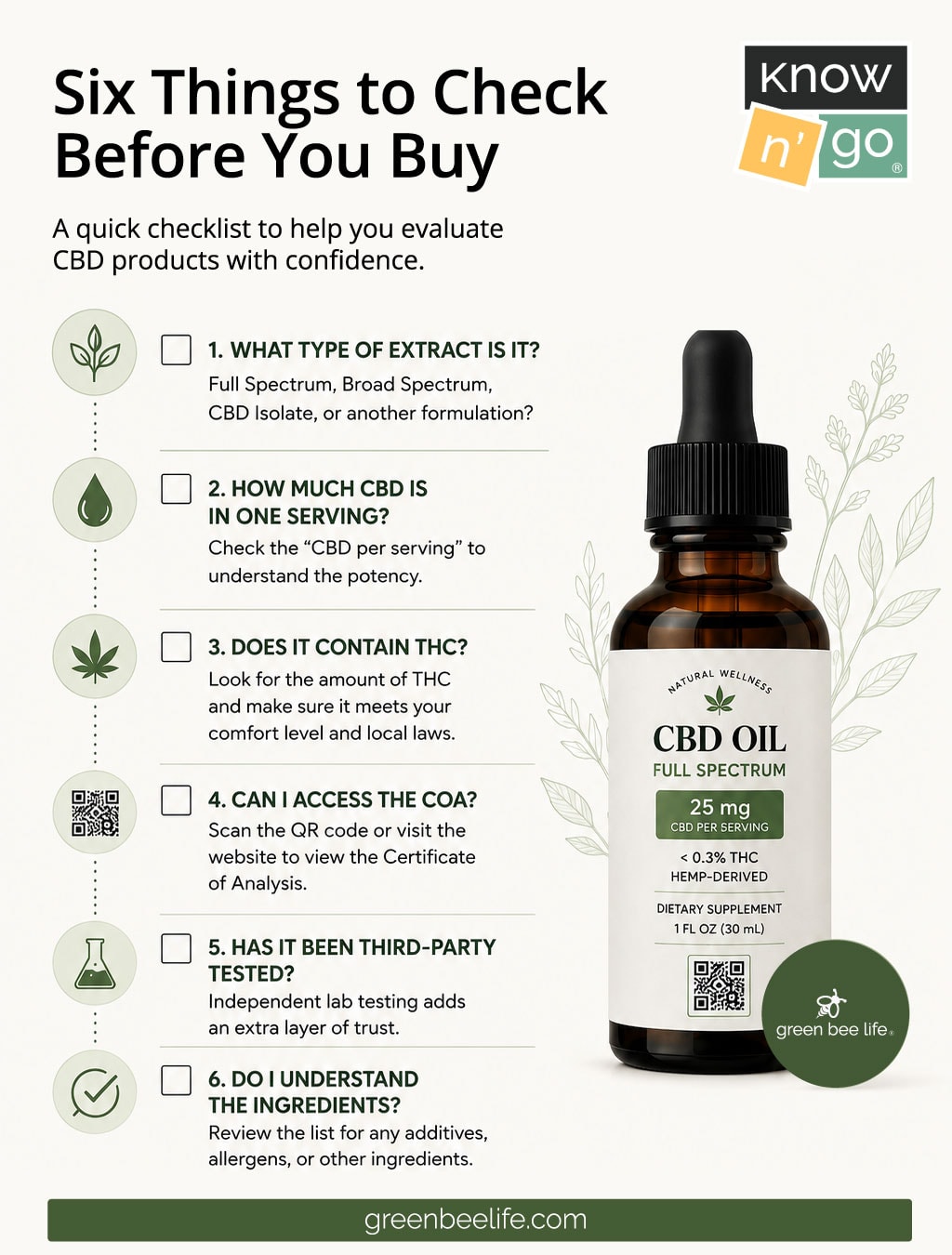
Before making a purchase, take a few moments to review both the product label and the Certificate of Analysis (COA). The Know n' Go® checklist below highlights some of the most important details to look for when comparing CBD products.
Pressed for time? Here's a quick recap of the key concepts from this guide. Whether you're shopping for your first CBD product, comparing different formulations, or simply expanding your understanding, these are the takeaways worth remembering.
Free Download
Know Your Why Before You Buy
Take this quick checklist with you the next time you're shopping for CBD. Learn what to look for on product labels, which questions to ask, and how to compare products with confidence.
The CBD marketplace continues to evolve, with new products, formulations, and terminology appearing every year. Learning the difference between CBD extracts, product formats, and common industry terms can help you compare products more confidently and better understand what you're buying.
The more you understand about CBD, the more confidently you can evaluate product labels, review Certificates of Analysis (COAs), and make informed decisions that are right for you. We hope this guide serves as a trusted foundation as you continue exploring the evolving world of hemp-derived CBD products.
At Green Bee Life Marketplace, we look for brands that emphasize clear labeling, third-party testing, and accessible Certificates of Analysis whenever available. While every person's needs and preferences are different, we believe transparency is one of the most important qualities to look for when evaluating CBD products.
Explore Hemp-Derived CBD Products in the Green Bee Life Marketplace →
The three primary CBD extract types are full-spectrum CBD, broad-spectrum CBD, and CBD isolate. They differ in the cannabinoids and other naturally occurring hemp compounds they contain. Understanding these differences can help you compare products and choose the option that best aligns with your preferences.
Neither is universally "better." The right choice depends on your individual preferences, your comfort level with THC, and the type of experience you're seeking. Understanding the differences between CBD extracts can help you choose the option that best aligns with your goals.
No. Nano CBD is not a fourth type of CBD extract. It refers to CBD that has undergone a manufacturing process called nanoemulsification, which creates smaller particles that may improve absorption. Nano CBD can be made using full-spectrum CBD, broad-spectrum CBD, or CBD isolate.
There's no one-size-fits-all answer. Many people begin with easy-to-measure products such as oils, tinctures, gummies, or capsules. The best choice depends on your personal preferences, your preferred product format, and whether you choose a full-spectrum, broad-spectrum, or CBD isolate.
A Certificate of Analysis (COA) is an independent laboratory report that helps verify a product's cannabinoid content and confirms testing for contaminants. Reviewing both the product label and the COA is one of the best ways to better understand what's in a product and make a more informed purchasing decision.
Affiliate Disclosure: Some links in this article are affiliate links. If you purchase through them, Green Bee Life may earn a small commission at no additional cost to you. These partnerships help support our educational mission and allow us to continue creating independent consumer resources.


How much CBD does your body actually absorb? Explore how gummies, tinctures, vaping, and topical products compare, why dietary fats matter, and practical ways to make more informed CBD choices.
Cannabis is more than THC and CBD. Explore the entourage effect, how cannabinoids, terpenes, flavonoids, and other plant compounds may interact, what the research actually shows, and what it could mean when choosing cannabis and CBD products.
Cannabis, hemp, marijuana, THC, CBD—what does it all mean? This Cannabis 101 guide breaks down the plant, its compounds, how it interacts with the body, ways cannabis is used, changing hemp laws, and what to know before choosing a cannabis product.
What is THC? Learn how it works in the body, how THC differs from CBD, potential benefits and risks, consumption methods, drug testing, legality, and what to know before choosing a product.
How much CBD does your body actually absorb? Explore how gummies, tinctures, vaping, and topical products compare, why dietary fats matter, and practical ways to make more informed CBD choices.
Cannabis is more than THC and CBD. Explore the entourage effect, how cannabinoids, terpenes, flavonoids, and other plant compounds may interact, what the research actually shows, and what it could mean when choosing cannabis and CBD products.
Cannabis, hemp, marijuana, THC, CBD—what does it all mean? This Cannabis 101 guide breaks down the plant, its compounds, how it interacts with the body, ways cannabis is used, changing hemp laws, and what to know before choosing a cannabis product.
What is THC? Learn how it works in the body, how THC differs from CBD, potential benefits and risks, consumption methods, drug testing, legality, and what to know before choosing a product.
Copyright © 2026 Green Bee Life | Green Bee LLC, is a subsidiary of Green Life Media, Inc., a full service creative agency and production company.
